


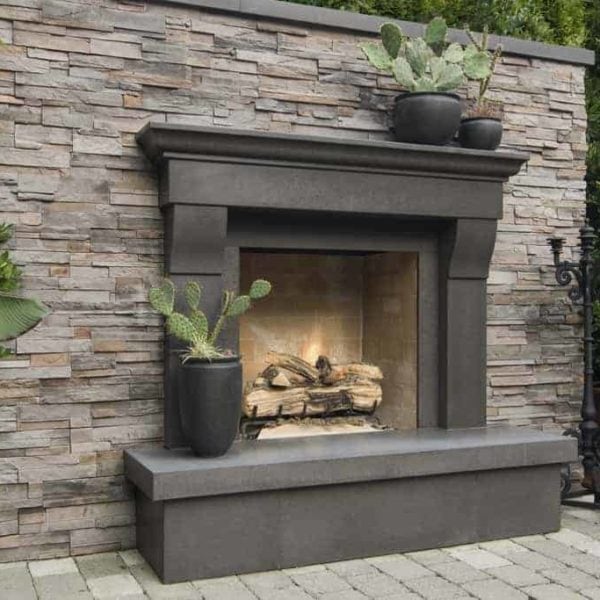
A fireplace surround is often the largest uninterrupted surface in a living room, lobby, or covered outdoor room. That is why concrete fireplace surrounds demand more than a color selection or a compelling rendering. Their success depends on proportion, material integrity, appliance requirements, substrate conditions, and the quality of the installation behind the finished face.
For projects built around clean lines and architectural restraint, concrete offers a rare combination of visual weight and quietness. It can frame fire without the visual busyness of patterned stone, ornate millwork, or tile grids. But concrete is not a generic finish. The formulation, construction method, panel size, and intended environment all affect how the surround will look and perform over decades of use.
Why Concrete Fireplace Surrounds Suit Modern Architecture
Concrete has a naturally monolithic character. It gives a fireplace a sense of permanence without requiring decorative excess. In a contemporary residence, a broad, handcast surround can establish a precise focal point while allowing furnishings, artwork, and views to remain part of the composition.
This is especially useful where the fireplace must connect different materials. A concrete surround can sit comfortably beside warm oak, blackened steel, plaster, glass, and natural stone because its finish is tactile rather than glossy. Its subtle variation is part of its appeal. A handcast surface should not be expected to resemble a digitally printed, perfectly uniform slab. Fine tonal movement, small pinholes, and evidence of the casting process give the material depth.
Scale matters as much as finish. A narrow surround may make a large firebox feel crowded, while a generously proportioned concrete plane can make a linear fireplace feel intentional rather than inserted into a wall. For hospitality and commercial spaces, that same visual authority helps a fireplace hold its own within taller ceilings, larger seating areas, and more demanding circulation patterns.
Choose the Concrete Construction, Not Just the Look
The term concrete can describe very different products. For a premium surround, the question is not simply whether the piece is made of concrete. It is how it is made, what it is reinforced with, and whether the construction is appropriate for the project environment.
UHPC, Not Layered GFRC
Ultra High Performance Concrete, or UHPC, is engineered for exceptional density and strength. When properly formulated and cast, it provides a refined, non-porous concrete body with high compressive strength and low water absorption. Those characteristics are particularly valuable in exterior applications, coastal environments, and regions where repeated freeze-thaw cycles can punish lesser materials.
GFRC, or glass fiber reinforced concrete, is commonly used for lightweight decorative components. It can be appropriate in certain applications, but buyers should understand how the product is constructed. Many GFRC pieces rely on layered material systems, with a sprayed face coat and backing layers. If those layers are compromised through impact, moisture exposure, or movement, the long-term appearance and durability of the piece can become a concern.
For exterior fireplace surrounds, a dense, through-body UHPC construction offers a more dependable foundation for long-term ownership. It is not an excuse to disregard proper detailing or installation, but it gives the finished assembly a materially stronger starting point. Solus Decor handcasts its architectural concrete products in British Columbia using UHPC for this reason.
Weight Is a Design Requirement
Concrete creates visual mass because it has actual mass. That is an advantage aesthetically, but it must be accounted for structurally. Large surround panels, mantels, and integrated hearths require a substrate and attachment strategy designed for their weight. A finish contractor should not be asked to solve this after the fireplace has been framed and the appliance has arrived on site.
The specification should establish panel dimensions, anticipated weights, mounting points, joint locations, and handling access before construction progresses. On renovation projects, verify the existing wall assembly rather than assuming it can accept a substantial cast-concrete component. A capable installer, clear shop drawings, and early coordination protect both the product and the schedule.
Specify the Fireplace Assembly as a System
A surround is not the fire appliance. It must be designed around the appliance manufacturer’s instructions, local code requirements, venting configuration, and listed clearances. This distinction is essential for safety, warranty compliance, and liability control.
Respect Clearances and Heat Management
Every gas or wood-burning fireplace has specific requirements for combustible materials, non-combustible finishes, mantel placement, ventilation, and service access. While concrete itself is non-combustible, the wall system behind it may include combustible framing, adhesives, insulation, or finishes. The full assembly must meet the appliance requirements, not merely the visible surface.
Do not assume that a concrete surround permits a firebox opening to be resized, a mantel to be lowered, or a vent detail to be concealed. Confirm all dimensions against the approved appliance documentation. Where an outdoor gas fireplace is involved, use certified equipment and ensure the fuel supply, controls, and commissioning process are handled by qualified professionals.
Plan for Movement, Joints, and Access
Concrete, steel framing, wood framing, and masonry do not all move at the same rate. Seasonal temperature shifts, building settlement, and normal material movement need room to occur without telegraphing stress through the surround. Depending on the design, that may mean deliberately placed shadow joints, flexible perimeter joints, or panelized construction rather than one oversized field-cast surface.
Access is equally practical. Gas valves, ignition components, blowers, and controls eventually require service. A successful design conceals service points without making routine maintenance destructive. This is particularly important in hotels, multi-residential projects, and restaurants, where downtime has operational consequences.
Interior and Exterior Conditions Are Not Interchangeable
An interior surround is protected from driving rain, standing snow, salt exposure, and extreme temperature change. An exterior surround is not. A material and installation detail that performs beautifully in a conditioned great room may be unsuitable on an exposed terrace in Montreal, Chicago, or the Pacific Northwest.
For exterior applications, consider where water will land, drain, and freeze. Avoid details that create horizontal ledges where water can sit. Keep joints and penetrations properly detailed. Account for the movement of adjacent cladding and the possibility of snow removal equipment, furniture impacts, or frequent cleaning around the fireplace.
Covered outdoor rooms reduce exposure, but they do not eliminate it. Wind-driven rain and winter humidity still reach surfaces that appear protected. In coastal settings, salt-laden air raises the standard further. A dense concrete material, correctly designed drainage, and experienced installation work together. None can substitute entirely for the others.
Design the Surround for the Whole Room
The strongest fireplace designs are not selected in isolation. The surround should relate to the room’s sightlines, ceiling height, hearth depth, seating arrangement, and lighting. A concrete surround can be pale and quiet against a textured plaster wall, or it can provide the darker grounding element in an otherwise light interior.
Color samples are useful, but samples should be viewed under the actual project lighting whenever possible. Daylight, warm LED lighting, firelight, and adjacent finishes all alter how concrete reads. A charcoal concrete may appear nearly black beside white oak in the afternoon, then reveal its warmer mineral undertones after dark.
Joint placement deserves the same attention. A visible horizontal reveal can add proportion to a tall surround and make large panels easier to transport and install. Conversely, an unnecessary grid of joints can weaken the monolithic effect that led the team to specify concrete in the first place. The right answer depends on scale, site access, and the visual intent.
Questions to Resolve Before Approval
Before releasing a concrete fireplace surround for production, the project team should be able to answer the following:
- Which appliance is being installed, and have its clearances and service requirements been confirmed?
- Is the surround interior, covered exterior, or fully exposed exterior?
- What wall structure, backing, and attachment method will carry the concrete components?
- Where will joints, access panels, vents, and control locations occur?
- Has the finish been reviewed alongside flooring, wall materials, lighting, and nearby metalwork?
These are not administrative details. They determine whether a design moves cleanly from concept to installation or becomes a series of site adjustments.
A concrete surround should earn its place through more than visual impact. When its material is selected for the climate, its geometry is coordinated with the appliance, and its installation is treated as an architectural assembly, it becomes a durable center of gravity for the room – one that remains composed long after the first fire is lit.
Have any questions?
Get in contact with the sales team to find out more about our products
or ask us in the chat at lower right of this screen.
Up Next

Sunday Times, November 2018
November 27, 2018

English Garden, August 2017
August 9, 2017
Dwell Magazine Online
November 28, 2016

LA Times
June 14, 2016

Salone LLC
August 7, 2026