


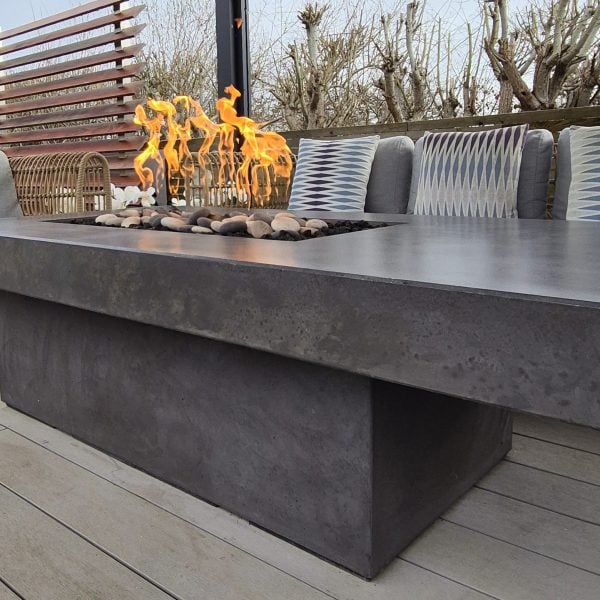
A concrete fire feature can look flawless on installation day and still reveal its true quality only after several winters, a coastal season, or years of heating and cooling cycles. That is why UHPC vs GFRC durability is not simply a material comparison. It is an ownership question for the homeowner, designer, builder, or hospitality operator responsible for how a feature performs long after the project is photographed.
Why the Construction Method Matters
Concrete is not one uniform material. Its performance depends on the mix design, reinforcement, curing process, wall construction, finishing method, and the manufacturer’s quality control. Two products with a similar cast-concrete appearance can have very different responses to moisture, impact, movement, salt, and thermal exposure.
GFRC, or glass fiber reinforced concrete, is a well-established material used across architectural applications. It is typically made as a relatively thin cementitious skin reinforced with alkali-resistant glass fibers. Depending on the product and manufacturing method, it may be sprayed or hand-packed in layers and supported by a backing or core. Properly engineered GFRC can be an appropriate choice for certain cladding, panels, and protected architectural applications where reduced weight is a primary requirement.
UHPC, or Ultra High Performance Concrete, is a dense, high-strength concrete composite designed around very low permeability and refined particle packing. It commonly incorporates steel or synthetic fibers within the full body of the mix. Rather than relying on a thin reinforced face coat over a separate backing system, a poured UHPC component is structurally consistent through its section.
That difference is particularly relevant for sculptural outdoor forms such as firebowls, fire tables, water features, and large architectural vessels. These products are expected to carry their own visual weight while managing weather exposure, service access, plumbing or gas integration, and frequent human contact.
UHPC vs GFRC Durability in Freeze-Thaw Climates
Freeze-thaw exposure is where material selection becomes highly visible. When water enters concrete and freezes, it expands. Repeated cycles can create internal stress, enlarge microscopic pathways, and eventually contribute to cracking, surface scaling, or finish deterioration. The risk is not confined to severe Canadian winters. Any climate with recurring temperature swings around freezing deserves careful consideration.
GFRC performance in freeze-thaw conditions depends heavily on formulation, curing, thickness, reinforcement placement, sealing, drainage, and installation. A well-produced GFRC item may perform successfully, but its layered construction creates more variables to control. If water reaches vulnerable interfaces, corners, penetrations, or damaged surface areas, the long-term outcome can depend on details that are no longer visible after installation.
UHPC is specified for demanding environments because its tightly packed matrix limits water absorption more effectively than conventional concrete mixes. In a properly made, fully cured UHPC form, low permeability reduces the amount of moisture available to drive freeze-thaw damage. The material’s high compressive strength and internal fiber reinforcement also help it resist cracking and impact-related damage that can become entry points for water.
This does not mean that a UHPC feature is immune to poor site conditions. Water should never be allowed to sit where it cannot drain, and the foundation, utilities, cover strategy, and winterization procedures still matter. But a lower-permeability, monolithic concrete construction gives the project a more durable starting point.
Coastal Exposure Is More Than a Surface Issue
Salt air, wind-driven moisture, and wet-dry cycling present a different but equally demanding test. Coastal conditions can accelerate degradation in porous materials and can expose weak points in coatings, sealants, and surface repairs. For commercial terraces, waterfront residences, resorts, and rooftop amenity areas, the concern is not only whether the concrete survives. It is whether the finish remains appropriate for a premium setting.
A dense UHPC body provides a meaningful advantage where moisture and airborne salts are persistent. The goal is not to suggest that every concrete feature will remain visually unchanged forever. All exterior materials weather, and natural tonal variation is part of concrete’s character. The objective is to reduce avoidable failure mechanisms, including excessive water intrusion, spalling, and premature surface breakdown.
Designers should also evaluate the complete assembly. Fasteners, burner components, drain connections, electrical elements, and support structures must be selected for the same exposure classification as the concrete feature. Durable concrete cannot compensate for unprotected hardware or an installation that traps water beneath the unit.
Fire Exposure Requires Material and Appliance Accountability
For gas fire features, concrete durability is only one part of the performance equation. The enclosure must tolerate normal operating heat, but the burner system, gas train, ignition, ventilation provisions, clearances, and control components require their own engineering and certification.
UHPC’s density and structural integrity make it well suited to refined fire feature forms, especially those with clean edges, substantial spans, or integrated tops. Yet no concrete material should be treated as a substitute for a tested appliance system. The relevant question is whether the manufacturer takes responsibility for the complete product, including material construction, burner design, certification, testing, installation requirements, and ongoing parts support.
For this reason, project teams should avoid comparing only a fire feature’s exterior dimensions and finish options. Ask how the appliance has been validated, what warranty applies to the burner and concrete body, and who owns the response if a field issue arises. Solus Decor builds its architectural fire features in UHPC and pairs that material standard with CSA-certified, bench-tested fire appliances and long-term warranty coverage.
Finish Retention Depends on More Than Color
A premium concrete finish should age with integrity. Minor variation, subtle patina, and the evidence of handcrafted casting are different from random cracking, delamination, or surface erosion. The distinction becomes especially important on broad horizontal surfaces, pale finishes, and monolithic forms placed close to seating, pool decks, and circulation paths.
GFRC’s fiber reinforcement improves tensile behavior in a thin section, but damage to the exterior face may be more consequential when that face is part of a layered system. UHPC’s through-body construction offers greater consistency if the surface receives a minor impact or abrasion. It also allows designers to specify strong, thin-looking geometries without making the object feel visually heavy.
Color and sealing still deserve realistic expectations. Exterior concrete should be maintained according to the manufacturer’s instructions, and harsh cleaning methods can alter any architectural finish. Specifiers should confirm approved cleaners, resealing guidance where applicable, and the expected appearance of natural weathering before final selection.
How to Specify for Long-Term Performance
The right material decision begins with exposure, not a product photo. A protected covered terrace in a mild climate has different demands than a lakefront patio in Ontario, a mountain residence, or a hospitality courtyard subject to daily use and winter maintenance.
During specification, establish whether the feature will experience standing water, freeze-thaw cycles, salt air, pool chemicals, heavy foot traffic, or frequent relocation. Review the foundation requirements and ensure the site can support the product’s weight without settlement. For fire features, coordinate gas supply, electrical requirements, clearances, drainage, and service access before the hardscape is complete.
It is also reasonable to ask direct manufacturing questions. Is the product a full-body poured concrete form or a layered shell? What reinforcement is used, and where? How is the concrete cured? What is covered by the warranty? Are replacement components available years later? Clear answers reveal whether a manufacturer is prepared to stand behind the product in the field, not just at delivery.
UHPC is not automatically the correct answer for every application. GFRC can be useful where weight restrictions, panelized construction, or a protected installation drive the project. But for freestanding outdoor fire and water features expected to withstand demanding weather while retaining a refined architectural presence, UHPC offers a more defensible durability position.
A well-specified feature should give the project team confidence at handover and the owner confidence years afterward. Choose the concrete construction, appliance system, and manufacturer support model with the same care given to the architecture around it.
Have any questions?
Get in contact with the sales team to find out more about our products
or ask us in the chat at lower right of this screen.
Up Next

Sunday Times, November 2018
November 27, 2018

English Garden, August 2017
August 9, 2017
Dwell Magazine Online
November 28, 2016

LA Times
June 14, 2016

Salone LLC
August 7, 2026