



Installing a propane firepit requires some calculations depending on the burner output. We have created a guide to make sure you don’t waste your time or money by using the incorrect size cylinder for your firepit’s BTU or kW output.
To start, here is a conversion list for BTUs (for North America) to kWs (for the UK and EU) to keep everything consistent: (note kWs are rounded up)
50k BTUs – 15kW
80K BTUs – 24kW
108k BTUs – 31kW (high output burner)
Next, we need to know how many kg/h or lbs/h each size of propane cylinder gives out, this is shown in Table 4.3:
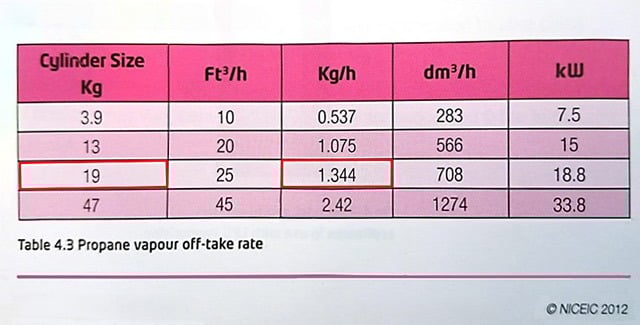
Table 4.4 shows the kg/h or lbs/h required for the kW rating (output) of the burner:
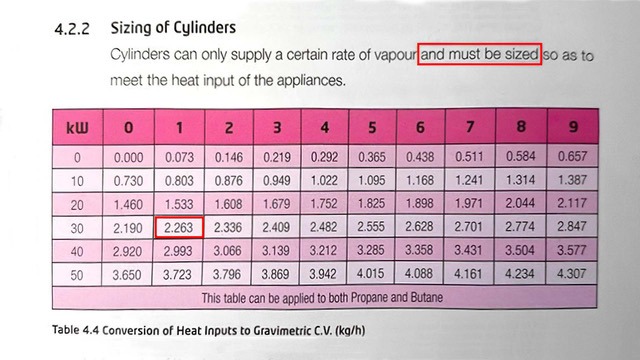
Using a 31kW rating as an example, one 31kW burner requires 2.263 kg/h, or 4.99 lbs/h of propane vapour.
In table 4.3, we can see that a 19kg (41.89 lbs) cylinder gives off 1.344 Kg/h (2.96 lbs/h)
We then simply divide the desired heat input of the burner in kg/h or lbs/h by the cylinder size in kg or lbs/h. So, 2.263 ÷ 1.344 = 1.684 or, 4.99 ÷ 2.96 = 1.684
Rounding this number up, approximately 1.7 19 kg/41.89 lb tanks are needed for a 31kW burner firepit. Therefore, you will need two cylinders to power your firepit.
Why using a propane vapour input just won’t work:
Using the same example as above, one 19kg (41.89 lb) cylinder can only deliver 18.8kW. So, If you hook up this size of cylinder to a 31kW burner, it’ll work for some time but that depends on the ambient temperature. However, the cylinder will ice up, starting from the base and rising to the top on the outside. Then, the cylinder will shut itself down to prevent liquid from being pulled out (an inbuilt safety feature). Following this, it will remain locked out until all the ice has dissipated, which might take a couple of hours.
In conclusion, to save yourself the hassle, take 5 minutes with these quick and easy instructions to make sure your propane firepit runs smoothly! If you’re still having trouble however, Solus is always happy to help either via email or phone, which you can find on our website!
Conversions used:
* 1 kg = 2.20462 lbs
* 2.263 kg/h × 2.20462 = 4.99 lbs/h
* 1.344 kg/h × 2.20462 = 2.96 lbs/h
* 19 kg × 2.20462 = 41.89 lbs