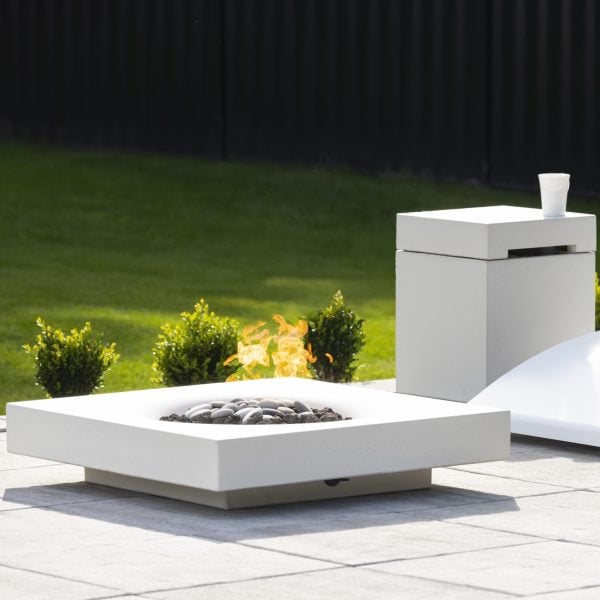
If you’re looking to bring some warmth and ambiance to your outdoor space, firepits are an excellent option. Not only are they practical, keeping you cosy late into the evening, but they naturally bring people together and initiate connection. However, choosing the right fuel type for your needs should be considered before jumping in. What fuel your firepit uses will impact performance, cost, and convenience. Your options include natural gas, liquid propane, ethanol and wood, lets look at how these compare.
1. Natural Gas (NG)
- Setup & Cost: NG firepits require installation of a natural gas line, this creates a higher initial cost, but minimal ongoing expenses.
- Performance & Convenience: NG burns cleanly and consistently. It is the most convenient option due to its continuous supply, with no tanks to refill or replace.
- Best For: Permanent outdoor setups where a gas line is accessible, such as homeowners seeking low running costs and ease of use.
2. Liquid Propane (LP)
- Setup & Cost: LP firepits can be hard-piped (similar to a NG line ) or connected via a hose (minimal, easy setup) to a propane tank. These are available in multiple sizes depending on the output requirements of your firepit (in BTUs or kWs).
- Performance & Convenience: LP provides a similar flame performance to natural gas. LP tanks need to be refilled and stored discreetly to maintain the aesthetic of your space if this is important to you.
- Best For: Installations where natural gas lines aren’t available or users who want flexibility or a temporary setup.
3. Ethanol (Bio-Fuel)
- Setup & Cost: Ethanol requires no setup cost, you simply fill from a small bottle and light. However, it is typically the most expensive fuel option.
- Performance & Convenience: Ethanol burns cleanly with no smoke, off-gas, or particulates. However, it has a limited flame control and cannot be regulated like NG or LP.
- Best For: Indoor or urban settings where NG or LP are not available. Users seeking a clean-burning, eco-friendly flame. Often chosen by apartment dwellers due to gas or wood-burning restrictions.
4. Wood
- Setup & Cost: No installation required, but ongoing fuel costs can be substantial depending on local wood prices. It also requires dry storage space for wood.
- Performance & Convenience: Provides an authentic crackling fire and strong heat output. However, drawbacks include smoke, ash cleanup, odor, and potential fire risk from sparks.
- Best For: Traditionalists who love the sound and smell of a real wood fire. It can also be a good option for rural areas where wood is inexpensive and readily available.
Summary comparison table:
| Fuel Type | Setup Cost | Running Cost | Maintenance/Convenience | Environmental impact |
| Natural gas | High, requires installing an NG line under your deck or patio area. | Low, once installed, it is the least. | Low maintenance, requires no further purchases as fuel is connected to the NG line supplying your home. | Moderate, NG burns very cleanly compared to wood and produces fewer particulates and less carbon monoxide. However, NG is still a non-renewable fuel and does require underground gas lines that can have an environmental impact. |
| Propane | Low, propane tanks are relatively inexpensive, the main expense is hiring a gas fitter to connect your firepit to the tank safely. | Moderate, cost of fuel depends on the burner output of your firepit, high-output burners require more fuel. | Moderate, maintenance of the gas hose may be required in winter, however propane tanks are easy to replace and don’t require replacing often. | Moderate, as with NG, it doesn’t create smoke or ash as wood does, but is still a non-renewable fuel. |
| Ethanol | Very Low, no “setup” is required, only the purchase of the ethanol. | High, ethanol burners use a substantial amount of fuel, which is expensive in comparison to alternative fuels. | Low maintenance, ethanol bottles mean no tank is required (that must be hidden or installed) and refueling is incredibly simple so it is highly convenient. | Low, made from renewable resources and burns cleanly with no smoke, soot or harmful gases. |
| Wood | Low, no “setup” is required, only the purchase of the wood. | Moderate, cost depends on your local area. | Moderate, ash and smoke can cause irritation and requires cleaning. Also, wood burning (compared to gas) firepits require more clearance from your home/furniture due to fire risk.# | Moderate, a renewable resource, but does produce smoke, particulates and carbon monoxide. |

Conclusion
To summarise, natural gas firepits are generally the most convenient and low-cost long-term. Propane firepits on the other hand, offer more flexibility and portability, which can be handy if you’d like to switch up your seating arrangements or when moving. Ethanol fuel is clean and simple, requiring no gas line installation or tanks and hoses. However, it is important to note this is the most costly option of the bunch. Lastly, classic wood burning firepits offer a traditional and atmospheric feel, but are high-maintenance and arguably not as safe as gas options with built in safety features. At the end of the day, your choice will depend on your space, budget, and how much maintenance you’re willing to take on. However if you’re looking for a bit more guidance, Solus is always happy to help! Feel free to get in touch using the contact details at the bottom of our website page.